


Color accuracy and color consistency are the top two requests I hear from brand owners every day, and for good reason—color fidelity is one of the most critical aspects of brand identity. For packaging and print applications, the ability to reproduce brand colors accurately can influence consumer perception and maintain consistency across global markets. As brands explore alternatives to traditional 4/c (CMYK) process printing, expanded gamut printing emerges as a compelling option. This approach introduces additional inks—such as orange, green, and violet—to increase the reproductible color range. However, the decision to adopt an expanded gamut environment requires careful consideration, specifically around color achievability and print capabilities.
From a brand perspective, color accuracy is typically the primary consideration when evaluating expanded gamut versus conventional 4/c process printing with spot colors. Factors such as brand color reproduction, spot color accuracy, and repeatability remain top priorities. While expanded gamut offers a broader color range, it is important to note that equity colors or highly critical brand colors will always be most accurate when printed as dedicated spot colors rather than converted into an expanded gamut print condition. To help illustrate this point, let’s take a look at what can be reproduced in 4/c process.
As a benchmark, the GRACoL2006_Coated1v2 print condition—representing standard CMYK—can reproduce approximately 60.00% of the 2023 master PANTONE Coated digital library within a 1.00 ΔE00 (1:1:1) tolerance. In this print condition, the average color difference of all PANTONE Coated colors is about 1.25 ΔE00, with the most challenging color, PANTONE Violet C, reaching nearly 11.00 ΔE00. This illustrates the inherent limitations of CMYK in achieving certain high-chroma or saturated hues, particularly in the violet and purple regions.
To evaluate the potential benefits of expanded gamut, let’s introduce additional inks to our conventional 4/c process to see what improvements may be expected. Taking the previously mentioned offset print condition (GRACoL 2006), we can add individual inks to explore the impact of adding specific pigments. Adding a violet (CMYKV) reduces PANTONE Violet C from ~11.00 ΔE00 to ~5.00 ΔE00 and increases the overall volume of achievable colors to 66.00% of the PANTONE Coated library. Adding orange (CMYKO) or green (CMYKG) produces similar results, with volume around 65.00%. While each single-ink addition improves performance, the most substantial gains occur when multiple inks are combined. A full 7/c configuration (CMYKOGV) achieves approximately 70.00% of the PANTONE Coated library, reducing the average color difference to around a 1.00 ΔE00. However, even with expanded gamut, violet and purple hues remain the most challenging.
While ink selection and configuration are imperative, it is not the only consideration. Each printing technology has its unique characteristics which impact color achievability and reproduction. Offset printing using CMYKOGV inks on coated recycled board achieves 73.50% of the PANTONE Coated library, with an average ΔE00 of 0.97. Flexography reverse printing on clear film with white ink achieves 82.00%, with an average ΔE00 of 0.67—a notable improvement over offset. Gravure reverse printing on clear film laminated to white poly delivers the largest gamut explored: 85.00% of the library, with an average ΔE00 of 0.43. All PANTONE colors fall below 10.00 ΔE00, making gravure the most accurate option out of the print conditions considered here. Lastly, digital printing reverse printing on shrink film achieves 71.00%, with an average ΔE00 of 1.05—the smallest gamut among the technologies evaluated. Across all technologies, violet and purple regions remain the most difficult to achieve. Though some technologies clearly indicate a higher volume of achievable colors, this does not mean that one technology should always be selected over another. The selection of a print technology for any given package may be influenced by best application, design intent, cost, timeliness, accessibility, and several other factors.
While expanded gamut may improve overall color reproduction, ink selection must be strategic. Adding orange, green, and violet inks is common, but not all print conditions respond equally. Factors such as substrate, print orientation, and ink formulation influence results. When choosing expanded gamut inks, consider hue angle and chroma relative to brand color requirements. The graphic below illustrates how additional inks extend the CIELAB color wheel, emphasizing the importance of targeted pigment selection.
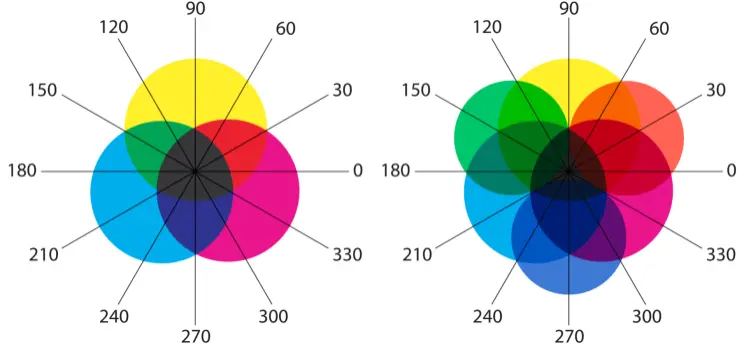
If ink selections are strategic, expanded gamut can be a viable and attractive option to brands, but results will vary by technology, ink configuration, and printing condition. As brands seek greater efficiency and sustainability, expanded gamut will continue to evolve—supported by advancements in technology, color management practices, and predictive analytics.
At Olberding, we work with expanded gamut every day across various package types, print technologies, and global suppliers. We help brands understand where their colors lie and whether expanded gamut will make a meaningful difference. We build controlled print conditions by measuring stability and verifying repeatability. And we connect these insights into real production decisions.
Our goal is to give brands confidence. If expanded gamut is a good fit for your brand portfolio, we will show you how to transition to this approach. If your portfolio is not the best candidate, we will tell you that too. It is all about clarity and strong decision-making.
If you would like any additional information on these findings, please reach out to me. If you want to explore whether expanded gamut could support your packaging, I am always happy to walk through your scenario and share what the data reveals!