

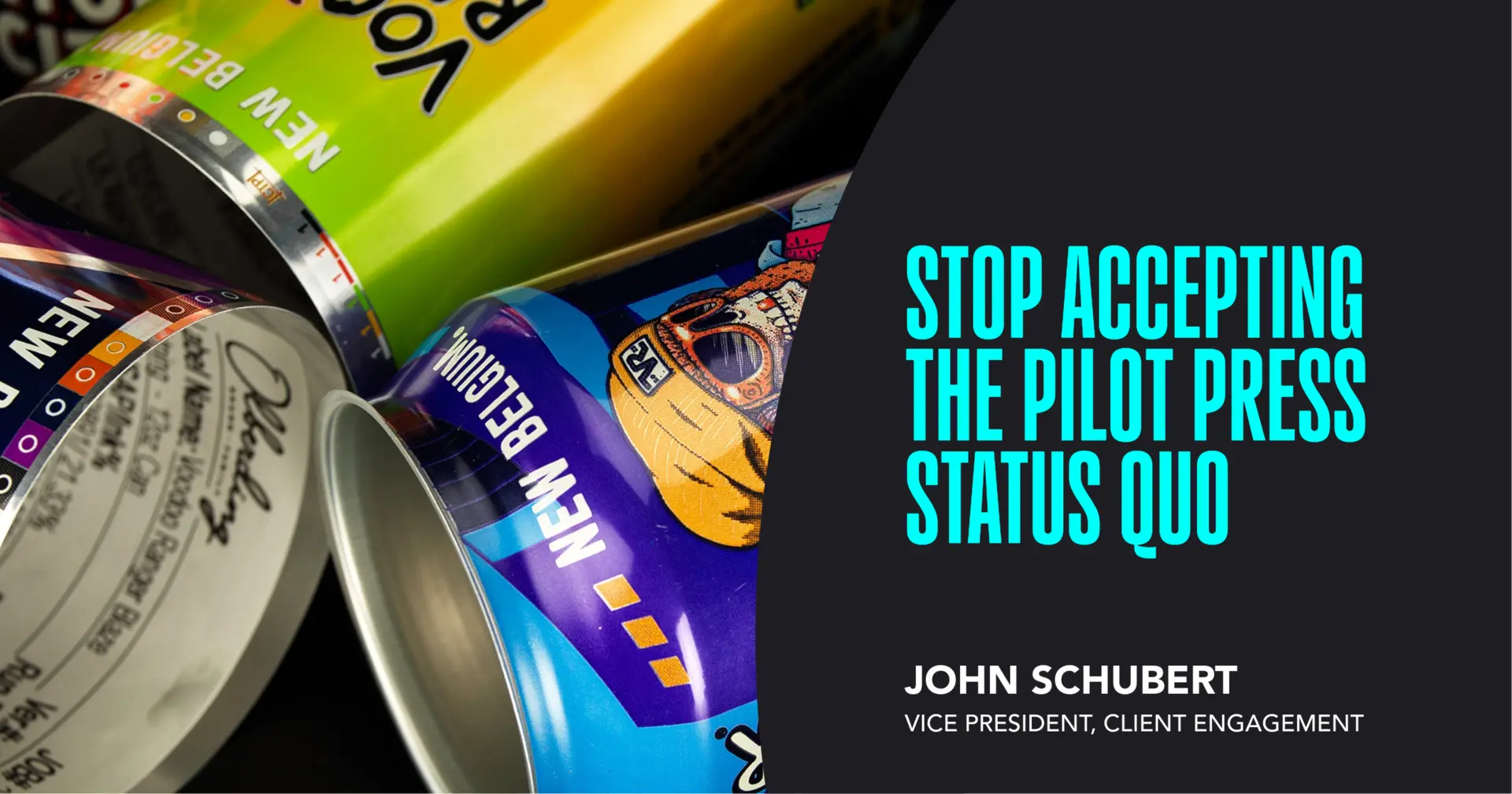
For an industry built on precision, packaging tolerates a surprising amount of friction. We invest millions in equipment, obsess over tolerances and color curves, and engineer for consistency at microscopic levels. And yet, the human experience of some of our most critical moments — like a press check — has often remained largely unchanged.
A few years ago, sparked by some frustrations a client shared before we even purchased our first pilot press, we began asking: Why does a metal deco press check sometimes feel harder than it should?
In metal deco – dry offset printing on aluminum cans – the technology is exceptional, the press is precise, and the science is advanced. But the pilot experience often follows the same long, drawn-out cycle of “run, review, reschedule.” Weeks are lost between iterations as creative intent slowly adjusts to fit production constraints. Press time is treated as scarce and rigid rather than strategic, and the people who pour months of thought into the brand often feel like observers rather than collaborators.
That isn’t a technology or equipment issue; it’s an experience issue.
When we realized the issue wasn’t the press — it was the experience — we had a choice: accept the system as it existed or build something better. So we invested in our own pilot press and set about redesigning the experience around it.
We asked ourselves:
We rebuilt the process around integration rather than handoffs, and we watched feedback loops collapse from weeks to hours. We created an innovation environment that enabled multiple runs in a single day. We anticipated production challenges and solved them before production began. We moved the conversation from “Here’s what it looks like,” to “Let’s make it better.”
The cans improved, but more importantly, the experience did as well, leading to better alignment, faster decisions, and stronger launches.
Metal deco was simply where this lesson became visible. The broader truth applies to packaging and beyond. Many business systems are optimized for operational efficiency, while fewer are optimized for human experience.
In complex brand environments, experience is infrastructure. When creative and graphic services operate as separate checkpoints across multiple agencies, friction is inevitable. But when they operate as one continuous brand deployment system within a single partner, integration and speed increase, and alignment strengthens.
That’s not a production-process upgrade; it’s a strategic shift.
At Olberding Brand Family, we’ve spent over a century building relationships, not conducting transactions. If the experience doesn’t reflect partnership or no longer serves our client, we need to rethink it.
Metal deco was one place we chose to raise the standard, and it won’t be the last. Better technology doesn’t automatically create better outcomes. Better-designed experiences do.
If you’re navigating complex brand execution and feel tension between creative ambition and production reality, you’re not imagining it. There is a better way to structure the work, and it starts with reimagining the experience.